


Back vs. Lay Explained: A Beginner’s Sports Exchange Guide
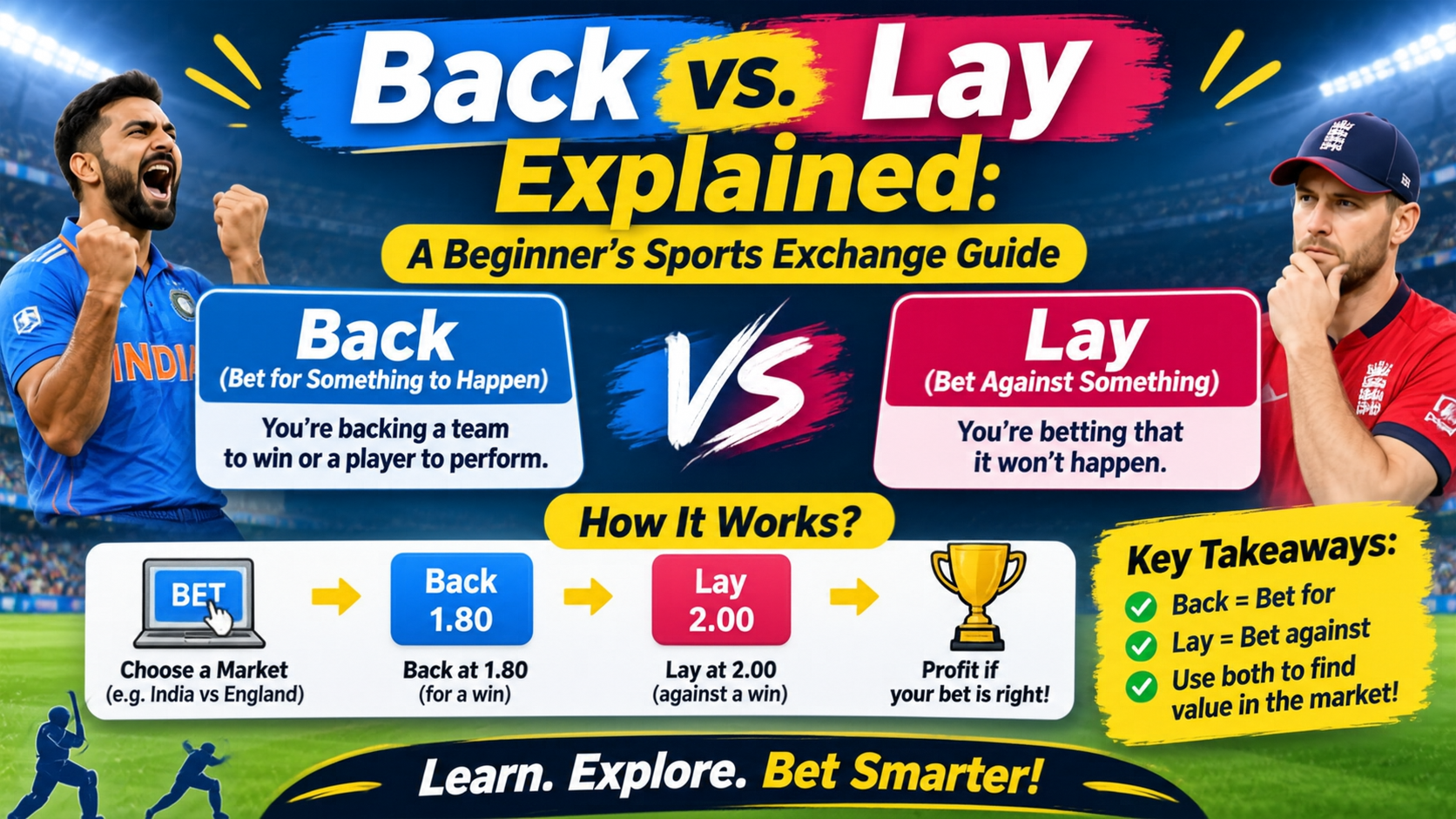
Understanding how digital sports exchanges work can seem confusing at first, especially when you come across terms like Back and Lay. These terms describe two opposite positions within an exchange market. Once you understand their meaning, it becomes easier to follow how market prices, available offers, and live updates work.
This beginner-friendly guide explains back vs lay, how the two concepts work, and the basic mechanics behind live sports exchanges.
What Does Back Mean?
A Back position means supporting a particular outcome because you believe it will happen.
For example, imagine a cricket match between Team A and Team B. If someone expects Team A to win, selecting Team A on the Back side represents that view.
The price displayed alongside the selection is known as the odds. It represents the market price associated with that outcome, rather than a guarantee of the final result.
In simple terms, Back means taking a position in favour of an outcome.
What Does Lay Mean?
Lay is the opposite of Back. It means taking a position against a particular outcome.
Using the same cricket example, if someone selects Team A on the Lay side, they are taking the opposite position to someone who expects Team A to win.
This creates two opposing sides within the same market. One supports a particular result, while the other represents the view that it will not happen.
In simple terms, Lay means taking the opposing side of an outcome.
Back vs. Lay: Understanding the Difference
The easiest way to understand back vs lay explained is to compare the two terms side by side.
|
Feature |
Back |
Lay |
|
Basic meaning |
Supports an outcome |
Opposes an outcome |
|
Market position |
Expects the selection to happen |
Expects the selection not to happen |
|
Opposite position |
Lay |
Back |
|
Main idea |
Supporting a result |
Taking the opposing view |
Both terms are connected to the same market but represent different positions. Understanding this distinction is the first step towards learning exchange terminology.
How Back and Lay Works in a Sports Exchange
To understand how back and lay works, it helps to know how an exchange market is organised.
1. Market Selection
An exchange market is created around a particular sporting event or outcome. For example, a cricket match may have a market based on which team will win.
2. Back and Lay Prices
The market displays prices for both sides. These prices can vary depending on available offers and activity within the market.
3. Matching Offers
One of the main features of an exchange is its matching system. A Back offer may be matched with a compatible Lay offer from another participant.
When the two sides match, the exchange records the transaction according to its rules.
4. Market Updates
Prices are not necessarily fixed. They can change as market conditions develop, particularly during live sporting events.
Understanding these steps makes it easier to follow the basic structure of a sports exchange.
How Live Sports Exchange Markets Change
Live markets are different from markets displayed before an event begins because they can respond to developments while the match is taking place.
Consider a cricket match. Several events may influence how the market changes:
-
A wicket falls: The match situation changes, which may affect the displayed prices.
-
A strong partnership develops: The balance of the match may shift.
-
A boundary is scored: The latest score can influence market expectations.
-
Rain interrupts play: A delay or change in match conditions may affect the market.
These examples show why live market prices can move quickly. They reflect changing market conditions and should not be treated as certain predictions.
Important Terms to Understand
Anyone reading a sports exchange guide should become familiar with a few common terms.
Odds: A numerical way of displaying the price associated with a particular outcome.
Market: The available selections connected to a sporting event.
Liquidity: The amount of available activity or interest within a market.
Matched offer: An offer that has been accepted by another participant.
Unmatched offer: An offer that has not yet been matched.
Live market: A market that remains active while an event is taking place.
Knowing these terms can make exchange interfaces and market information easier to understand.
Why Do Back and Lay Prices Change?
Back and Lay prices may change for several reasons. These include developments during the event, changes in available offers, and shifts in market activity.
For example, a cricket match may look different after a team loses several wickets. The market may respond by displaying different prices for the available outcomes.
However, price movements do not guarantee what will happen next. They simply show how the market is changing at that moment.
Common Misunderstandings About Back and Lay
Beginners sometimes misunderstand how exchange markets operate. Here are a few points worth remembering:
-
Back and Lay are opposite positions, not two names for the same action.
-
Displayed prices can change during an event.
-
An offer is not necessarily matched as soon as it appears.
-
Market prices do not guarantee the final outcome.
-
Live market activity can involve financial risk.
Understanding these points helps create a more accurate picture of exchange mechanics.
Frequently Asked Questions
1. What does Back mean in a sports exchange?
Back means taking a position that supports a particular outcome, such as expecting a team to win a match.
2. What does Lay mean?
Lay means taking the opposite position. It represents the view that a selected outcome will not happen.
3. How do Back and Lay differ?
Back supports an outcome, while Lay opposes it. They represent two different sides of the same exchange market.
4. Can Back and Lay prices change during a live match?
Yes. Prices can change as match conditions develop and market activity shifts.
5. What is a matched offer?
A matched offer is an offer that has been accepted by another participant through the exchange's matching system.
6. What is liquidity in a sports exchange?
Liquidity refers to the amount of available activity or interest in a particular market. It can influence how easily compatible offers are matched.
Final Thoughts
Back and Lay are two fundamental terms used in exchange-based sports markets. Back represents a position in favour of an outcome, while Lay represents the opposing position.
Understanding how these positions work, how offers are matched, and why live prices change can make exchange terminology much easier to follow.
For beginners, the best starting point is to learn the basic concepts rather than make assumptions based on changing market prices. It is also important to understand that these activities may involve financial risk and that no market position guarantees a particular result.
Disclaimer: This article is for general educational purposes only. It does not provide financial advice or encourage participation in any activity.
 Turkish
 English
 Arabic
 French
 Spanish
 Portuguese
 Deutsch
 Dutch
 Italiano
 Russian
 Romaian
 Portuguese (Brazil)
 Greek