


Slant Bed Lathe: Gravity Does the Cleaning
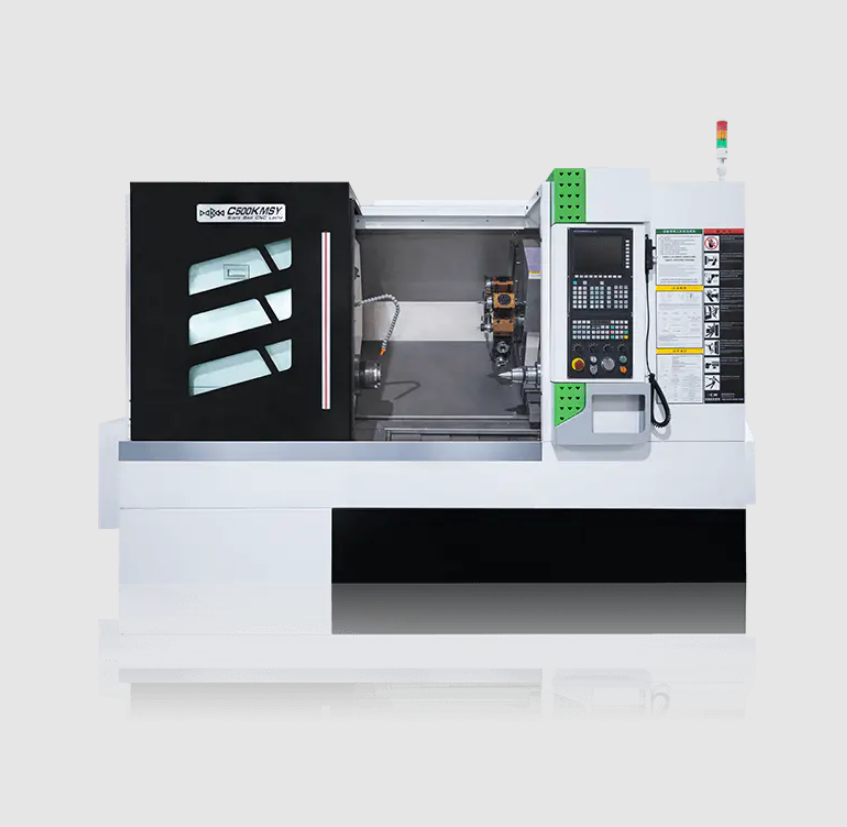
Anyone who has spent time around a turning shop knows that chips are quiet troublemakers. They pile up, wrap around tools, and sneak into places they have no business being. A slant bed lathe tackles the problem with a simple trick: tilt the bed and let gravity do the sweeping.
The bed on a slant bed lathe usually sits at an angle between 30 and 45 degrees. Cutting debris drops straight into the conveyor instead of settling on the guideways or around the workpiece. For buyers running long shifts, that means fewer interruptions, steadier surface finish, and less time spent clearing the cutting zone by hand. Operators can keep their attention on the part rather than on the pile growing beside it.
Rigidity is the second reason purchasing managers study this machine type. The slanted layout allows a wider, deeper casting with generous ribbing. A heavy base absorbs vibration during interrupted cuts, so tolerances hold when work moves from soft aluminum to hardened alloy steel. A slant bed lathe built this way also makes tool life easier to predict, and production planners value predictability.
Operator access deserves a mention too. With the bed tilted back, the turret and chuck sit closer to the front, so a technician can reach the work area without leaning over a long flat bench. Loading a heavy shaft, checking an insert, or measuring a bore feels less like gymnastics. For plants dealing with staff turnover, a slant bed lathe that new operators learn quickly is a practical advantage.
Thermal behavior is another quiet strength. Hot chips fall away fast, so less heat travels into the spindle housing. Dimensional drift between the first part of the morning and the last part of the evening stays small. Customers supplying medical, hydraulic, or aerospace components often demand tight consistency across large batches, and a slant bed lathe supports that expectation without special tricks.
No machine suits every job. Very large flanges or oversized castings may call for a different structure. But for shafts, sleeves, flanges, and valve bodies in the small to medium range, the slant bed lathe offers a balanced mix of stiffness, chip control, and ergonomics.

 English
 French
 Spanish
 Portuguese
 Deutsch
 Turkish
 Dutch
 Italiano
 Russian
 Romaian
 Portuguese (Brazil)
 Greek