


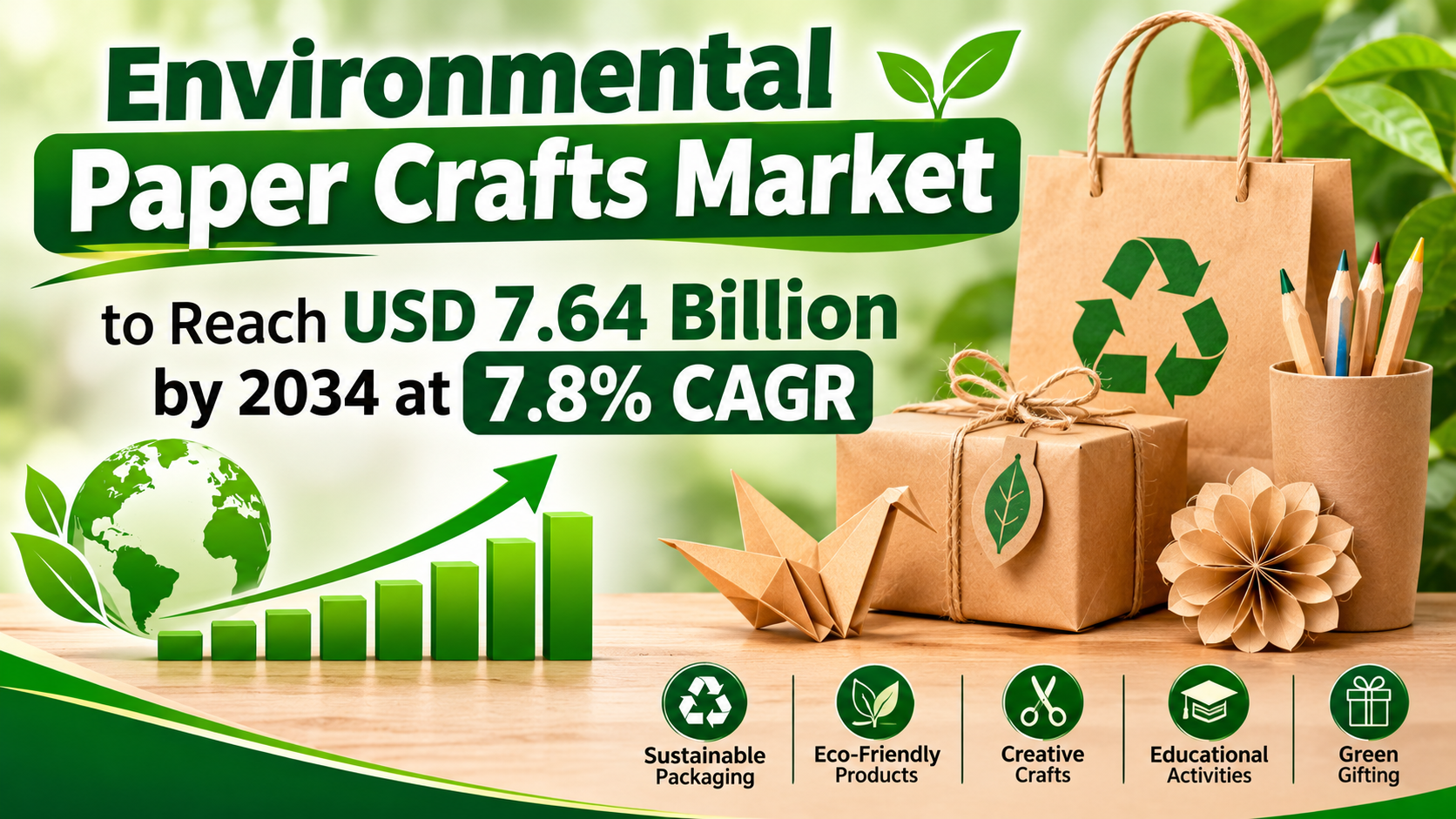
Environmental Paper Crafts Market to Reach USD 7.64 Billion by 2034 at 7.8% CAGR
Global Environmental Paper Crafts Market is gaining attention across food and beverage packaging, art and design, educational activities, sustainable gifting, stationery, decorative products, and eco-friendly consumer goods. Environmental paper crafts, also known as eco-friendly paper crafts, involve the use of recycled or sustainably sourced paper and other natural materials to create functional and decorative products. These products include lunch boxes, lids, egg trays, greeting cards, journals, gift boxes, and ornamental items. The manufacturing process emphasizes environmental conservation through recycled materials, non-toxic adhesives, and reduced material wastage.
According to 24ChemicalResearch latest industry analysis, the global Environmental Paper Crafts market was valued at USD 3.87 billion in 2025 and is projected to grow from USD 4.18 billion in 2026 to reach USD 7.64 billion by 2034, exhibiting a compound annual growth rate (CAGR) of 7.8% during the forecast period. Rising global awareness of environmental sustainability, increasing consumer preference for biodegradable and recyclable packaging solutions, and tightening regulations aimed at reducing single-use plastics are supporting market expansion. Growing demand from food and beverage businesses, educational institutions, and environmentally conscious consumers is further strengthening the industry's growth prospects.
View the complete report:
https://www.24chemicalresearch.com/reports/271178/global-environmental-paper-crafts-forecast-market
Environmental paper crafts encompass a broad range of products manufactured using recycled paper, sustainably sourced paper, cardboard, and alternative natural fibers. These materials are increasingly used to produce functional packaging products, handmade stationery, decorative items, and creative craft supplies. The incorporation of non-toxic adhesives, plant-based dyes, and waste-minimization practices further strengthens the environmental credentials of these products. As consumers and businesses increasingly prioritize sustainable purchasing and procurement practices, environmentally responsible paper craft products are gaining importance across commercial and individual applications.
What Is Driving the Environmental Paper Crafts Market?
Three primary forces are propelling market expansion, each independently capable of sustaining growth while collectively amplifying demand across sustainable packaging, creative industries, and educational applications.
Rising Consumer Awareness Around Sustainability and Eco-Conscious Lifestyles
The Environmental Paper Crafts market is experiencing robust momentum, driven primarily by a broad shift in consumer preferences toward sustainability. Across North America, Europe, and increasingly Asia-Pacific, households and educational institutions are replacing synthetic craft materials, including plastics, styrofoam, and petroleum-derived adhesives, with biodegradable, recycled, and sustainably sourced paper alternatives.
Parents, educators, DIY enthusiasts, and environmentally conscious consumers are increasingly seeking craft products that align with their environmental commitments. Recycled greeting cards, eco-friendly gift boxes, journals, and decorative paper products are gaining popularity among consumers who prioritize responsible material sourcing. This behavioral transition is supporting demand for sustainable craft supplies and encouraging manufacturers to expand environmentally responsible product portfolios.
View the complete report:
https://www.24chemicalresearch.com/reports/271178/global-environmental-paper-crafts-forecast-market
Growth of DIY Culture and Craft-Based Education Platforms
The global proliferation of DIY culture, supported by social media platforms and online learning communities, is expanding the consumer base for environmental paper crafts. Online communities dedicated to handmade art, nature-inspired projects, and sustainable living are encouraging consumers to explore environmentally friendly craft materials and creative activities.
Educational institutions are also incorporating paper crafting into STEAM (Science, Technology, Engineering, Arts, and Mathematics) curricula. Teachers and curriculum designers increasingly use origami, papier-mâché, seed paper, and recycled-paper sculpting to combine creative development with environmental education. This integration is generating institutional demand for eco-certified paper craft materials.
Corporate wellness programs and community engagement initiatives are providing additional opportunities. Organizations incorporating sustainability into their business identities are adopting environmental paper craft workshops for team-building activities and corporate social responsibility programs, broadening demand beyond traditional retail consumers.
Supportive Regulatory Frameworks and Green Procurement Policies
Government-led sustainability initiatives and green procurement policies across the European Union, United States, Canada, and parts of Southeast Asia are creating favorable conditions for environmentally certified paper craft products. Regulations restricting single-use plastics and encouraging recycled materials in consumer goods are indirectly increasing demand for paper-based alternatives.
Educational institutions operating under public procurement frameworks are increasingly required to source materials that comply with environmental standards. Private-sector environmental, social, and governance (ESG) commitments are also encouraging companies to incorporate sustainable packaging, stationery, and gifting products into their procurement strategies. These developments are creating favorable long-term conditions for environmental paper craft manufacturers.
Market Challenges and Restraints
Price Competitiveness Against Conventional Craft Materials
Despite the environmental benefits of sustainable paper crafts, price sensitivity remains a significant barrier to broader market adoption. Eco-certified and recycled-content paper craft products often carry higher costs than conventional synthetic or non-certified alternatives because of raw material expenses, certification fees, and more complex supply chains.
In price-sensitive emerging markets and budget-constrained educational institutions, these cost differences can influence purchasing decisions. Manufacturers must improve production efficiency and supply-chain management while maintaining the sustainability standards that differentiate their products.
Inconsistent Raw Material Quality and Supply Chain Fragmentation
The environmental paper crafts industry depends on recycled paper mills, sustainably managed forestry operations, and artisanal material producers. Differences in production standards and supply availability can create inconsistencies in paper texture, weight, and colorfastness.
Manufacturers requiring consistent craft-grade paper specifications may encounter sourcing difficulties, particularly when recycled fiber availability becomes limited or demand increases. These supply-chain challenges can affect production planning, product quality, and operating margins.
Limited Consumer Awareness in Developing Markets
Although awareness of eco-friendly products is well established in many mature markets, significant consumer groups across South Asia, Latin America, and Sub-Saharan Africa remain less familiar with environmental paper crafts.
Limited specialty retail infrastructure, insufficient sustainability-focused educational content, and the availability of lower-cost conventional alternatives can constrain adoption. Addressing these challenges requires investment in consumer education, localized marketing, and regional distribution partnerships.
Greenwashing Concerns and Certification Complexity
Unsubstantiated environmental claims can undermine consumer confidence in sustainable paper craft products. The absence of universally standardized labeling requirements in some markets makes it difficult for buyers to distinguish genuinely sustainable products from those with superficial environmental claims.
Additionally, certification frameworks such as FSC, PEFC, EU Ecolabel, and Green Seal create compliance requirements for manufacturers operating across multiple markets. Certification costs and administrative responsibilities can disproportionately affect smaller producers and importers.
Durability and Performance Limitations
Paper-based materials are generally more susceptible to moisture damage, tearing, and structural degradation than synthetic alternatives such as plastic sheets, foam, and resin-based materials. These limitations can affect applications requiring long-term durability, including outdoor decorations and functional products.
Although plant-based water-resistant coatings and improved paper treatment technologies are helping address these limitations, affordable high-performance eco-paper craft materials remain an important development challenge.
View the complete report:
https://www.24chemicalresearch.com/reports/271178/global-environmental-paper-crafts-forecast-market
Market Opportunities
Expansion into Sustainable Gifting, Packaging, and Event Decoration Segments
The growing consumer preference for sustainable gifting and environmentally responsible event experiences presents an important opportunity. Handmade paper gift wrapping, seed paper greeting cards, recycled-content party decorations, and biodegradable confetti are creating additional product opportunities for environmental paper craft manufacturers.
Millennials and Gen Z consumers increasingly associate purchasing decisions with environmental values and brand identity. Companies capable of offering attractive, environmentally responsible products for celebrations, gifting, and special occasions can expand beyond traditional craft markets.
Digital Commerce and Subscription Model Innovation
The growth of direct-to-consumer e-commerce and craft subscription services is creating scalable distribution opportunities. Monthly and seasonal subscription boxes containing eco-paper craft kits can attract consumers interested in nature, mindfulness, handmade products, and sustainability education.
Digital marketplaces and brand-owned websites also allow smaller artisan manufacturers to reach international audiences without significant investment in physical retail infrastructure. Subscription models can improve customer engagement, support predictable inventory planning, and provide valuable consumer feedback.
Integration with Circular Economy Initiatives and Community Upcycling Programs
Environmental paper crafts are well positioned to benefit from the expanding circular economy movement. Partnerships with municipal waste management programs, corporate sustainability departments, and environmental education organizations can create new supply and distribution opportunities.
Community upcycling initiatives that transform post-consumer paper waste into artwork, functional products, and educational materials are gaining attention. Manufacturers that integrate recycled materials and transparent sustainability practices into their operations can benefit from growing demand for circular economy solutions.
Market Segmentation Insights
The Environmental Paper Crafts market is segmented by type, application, end user, raw material, and distribution channel. Each dimension reveals distinct competitive dynamics and investment opportunities, allowing stakeholders to identify important growth areas across sustainable packaging and creative industries.
By Type
The market encompasses Lunch Boxes, Lids, Egg Trays, and Others. Lunch Boxes represent the most prominent product type, driven by the increasing adoption of sustainable food packaging solutions across retail and foodservice industries. Manufactured using recycled or sustainably sourced paper, these products provide alternatives to conventional single-use plastic packaging.
Egg Trays also hold a meaningful position in the market because of their widespread use in protecting fragile products during transportation and storage. The Others category includes greeting cards, gift boxes, journals, ornamental products, and other functional and decorative paper craft items that are gaining popularity among environmentally conscious consumers.
By Application
Key application sectors include Food and Beverage, Art Design, and Others. Food and Beverage represents the dominant application segment, supported by increasingly stringent regulations on plastic packaging and growing awareness of sustainable consumption. Restaurants, cafes, catering businesses, and grocery retailers are increasingly transitioning toward paper-based packaging solutions.
The sector's demand for hygienic, reliable, and aesthetically appealing eco-friendly packaging is encouraging manufacturers to improve material quality and structural designs. Art Design represents an emerging and rapidly growing application area, supported by handmade and DIY craft movements. Artisans, designers, and educators use recycled and plant-based papers to create decorative products, educational materials, and artistic installations.
By End User
Key end-user categories include Commercial Enterprises, Individual Consumers, and Educational Institutions. Commercial Enterprises represent the leading end-user segment, encompassing food manufacturers, retailers, hospitality providers, and corporate gifting companies requiring large volumes of environmentally responsible paper craft products.
These businesses increasingly integrate sustainable materials into their supply chains as part of broader ESG strategies and environmental commitments. Individual Consumers represent an important segment, particularly among younger demographics interested in sustainable lifestyles, creative hobbies, and eco-conscious gifting.
Educational Institutions also contribute meaningfully to market demand as schools, universities, and community organizations incorporate eco-friendly paper crafts into creative learning activities and environmental awareness programs.
By Raw Material
The market includes Recycled Paper, Tree-Free Paper, and Sustainably Sourced Virgin Paper. Recycled Paper represents the dominant raw material segment, supported by waste reduction initiatives and established post-consumer and post-industrial paper collection systems.
Tree-Free Paper, manufactured using alternative natural fibers such as bamboo, sugarcane bagasse, and banana fiber, is gaining momentum as an alternative to conventional wood-pulp paper. These materials offer opportunities for manufacturers to diversify raw material sources and develop distinctive sustainable products.
Sustainably Sourced Virgin Paper, certified by organizations such as the Forest Stewardship Council (FSC), provides manufacturers with another option for maintaining consistent material quality while supporting responsible sourcing practices.
By Distribution Channel
Key distribution channels include Online Retail, Specialty Eco Stores, and Supermarkets and Hypermarkets. Online Retail has emerged as the fastest-growing and increasingly dominant distribution channel, driven by e-commerce platforms catering to eco-friendly and handmade product categories.
Online marketplaces and direct-to-consumer websites enable small artisan manufacturers to reach wider audiences while providing consumers with convenient access to sustainable products. Specialty Eco Stores serve consumers seeking curated product selections, expert guidance, and environmentally responsible brands.
Supermarkets and Hypermarkets continue to play an important role in increasing mainstream accessibility, particularly for food packaging products that benefit from bulk purchasing and extensive retail distribution networks.
Report Summary
The Environmental Paper Crafts Market is witnessing strong growth as rising environmental awareness, increasing adoption of biodegradable packaging, regulatory initiatives, and expanding DIY and craft-based educational activities drive demand for sustainable paper products. The growing use of recycled and alternative natural fibers, coupled with the expansion of e-commerce and sustainable gifting applications, is supporting the market's positive growth trajectory.
Key Report Highlights:
-
The global Environmental Paper Crafts Market was valued at USD 3.87 billion in 2025.
-
The market is projected to grow from USD 4.18 billion in 2026 to USD 7.64 billion by 2034.
-
The market is expected to expand at a CAGR of 7.8% during the forecast period.
-
North America represents the leading regional market, supported by established sustainability awareness, mature retail infrastructure, and strong demand for eco-friendly paper products.
-
Asia-Pacific represents a high-potential growth region, with China, India, Japan, and South Korea contributing to increasing demand.
-
Lunch Boxes represent the most prominent product type, supported by growing adoption of sustainable food packaging.
-
Food and Beverage represents the dominant application segment, driven by demand for biodegradable and recyclable packaging alternatives.
-
Commercial Enterprises represent the leading end-user segment, supported by sustainable procurement and corporate ESG initiatives.
-
Recycled Paper dominates the raw material segment, while tree-free paper made from bamboo, sugarcane, and banana fiber is gaining momentum.
-
Online Retail represents the fastest-growing and increasingly dominant distribution channel.
-
Major growth drivers include rising sustainability awareness, expansion of DIY culture, craft-based education, and supportive green procurement policies.
-
Key market challenges include price competitiveness, inconsistent raw material quality, limited consumer awareness, greenwashing concerns, and certification complexity.
-
Emerging opportunities include sustainable gifting, eco-friendly event decoration, digital commerce, subscription-based craft kits, and circular economy initiatives.
-
The competitive landscape includes Green Field Paper Company, Botanical PaperWorks, Earth Greetings, Tree-Free Greetings, Green Banana Paper, Jingmen Green Environmental Protection Paper Products, and Ji Ning Yu Lin Zhi Zhi Co.
-
The report provides comprehensive insights into market size, growth forecasts, product segmentation, application trends, end-user analysis, raw material developments, distribution channels, regional trends, competitive analysis, and strategic opportunities shaping the global Environmental Paper Crafts Market through 2034.
View the complete report:
https://www.24chemicalresearch.com/reports/271178/global-environmental-paper-crafts-forecast-market
Download the free sample report:
https://www.24chemicalresearch.com/download-sample/271178/global-environmental-paper-crafts-forecast-market
Contact Us
Website: https://www.24chemicalresearch.com/
Asia: +91 9169162030
Email: help@24chemicalresearch.com
 Portuguese (Brazil)
 English
 Arabic
 French
 Spanish
 Portuguese
 Deutsch
 Turkish
 Dutch
 Italiano
 Russian
 Romaian
 Greek