


What Students Should Check in Their References Before Submitting Coursework
1. Understanding the Topic
You have hit the word count. The last paragraph finally reads well. You are one click from submitting.
Then you spot it. An author from section two is missing from your reference list, and a citation says 2019 while the list says 2018.
Small slips, yes. But they plant an uncomfortable thought: if these are wrong, what else is?
Although marking approaches vary, a reference list gives the reader a quick way to trace the sources behind your main arguments. Missing or inconsistent details make that harder.
Why references go wrong at the last minute
Most errors do not happen when you first write a reference. They happen during editing.
You cut a repetitive paragraph, so the citation goes but the full reference stays. Then you add a stronger source late at night and forget the list. Nobody is being careless. The assignment simply changed after the references were built.
A reference list is only accurate on the day you finish editing, not the day you first built it.
That is why this check belongs at the very end.
2. Common Problems or Concerns
What a reference is really doing
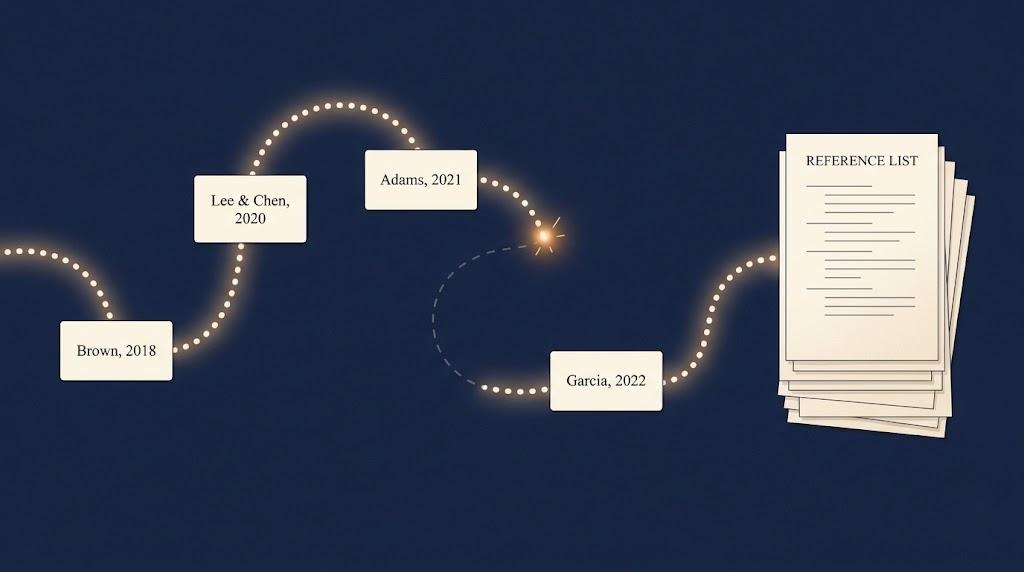
A citation and a reference are two halves of one promise. The in-text citation says, “this idea came from here.” The full reference tells the reader exactly where “here” is.
If either half is wrong, the trail breaks.
For undergraduates, that trail usually supports established theories. For postgraduates, it carries more weight, because a literature review may set several studies against each other. One wrong year can leave a reader unsure which study you mean.
Where citations and references stop matching
The most common mismatch is an orphan: a full reference that nothing in the text cites, or a citation with no entry in the list. Both usually come from late edits.
Harvard, APA and MLA are the usual systems, but departments adapt them. Your module handbook always beats an example from a random website.
3. Key Theories or Concepts to Know
A correct reference is not the same as a reliable claim
A reference can be perfectly formatted and still work against you.
Say a study finds that employee satisfaction and productivity rise together. Your coursework says satisfaction “causes” higher productivity. The reference is flawless. The claim is not, because two things moving together is not proof that one drives the other.
A correctly formatted reference does not make a source reliable, and it does not prove the source supports your claim.
For every key citation, ask: would the author agree with the way I have put this? If you are unsure, go back to the original and read the findings again.
4. Key Factors to Consider
The same distinction matters when reviewing academic work, including work covered by a Coursework Proofreading Service UK. A reference may be correctly formatted, but the claim attached to it still needs to reflect what the original research actually found.
Check the details in separate passes. Doing everything at once is how things slip through.
Authors. Check spelling, initials and order. Government reports and charity publications often belong to an organisation, not to a person named on the cover.
Dates. Journal articles often appear online before they join a final issue. Follow your referencing guide on which date to use, then apply it consistently.
Titles and publication details. Check subtitles, journal names, volume, issue and page range. For books, check the edition and publisher.
Web sources. Note the page title, the organisation responsible, the date and any DOI or URL your style requires. A page can be updated many times without its original date changing.
5. Practical Guidance
Build a Citation Ledger
Reading your reference list over and over rarely catches much. Your eyes start to skim. A ledger works better.
Open a blank document and make three columns:
- Column one: every citation in your text, in order.
- Column two: the matching full reference.
- Column three: the page or section in the original where the evidence sits.
Then check it in both directions.
Forward check: does every citation have a full reference?
Reverse check: does every reference have a citation?
The reverse check is the one people skip, and it is where orphan references hide. Column three pays off later too. When you rewrite a paragraph, you can confirm in seconds that your new wording still represents the source fairly.
Checking each citation against its full reference takes patience, but it is nearly always worth doing before you submit.
Check your quotations
Compare each quotation with the original wording and confirm the page number. If you shortened a quote, make sure the meaning has not shifted.
Reference list or bibliography?
These are not the same thing. A reference list contains only the sources you cited. A bibliography may also include material you read but did not cite. Check your assessment instructions to see which one is required.
6. Mistakes to Avoid
Some errors keep appearing because students focus on how a reference looks instead of what it says.
Trusting citation generators completely. They are handy for a first draft, but imported details can be incomplete or wrongly formatted. Compare every generated entry with the source.
Mixing styles. A Harvard example for a journal article and an APA example for a book can each look right alone. Together, they make the list inconsistent.
Mixing up primary and secondary sources. If a textbook described another researcher’s study, do not present that study as though you read it yourself. Find the original, or follow your style’s rules for secondary referencing.
Guessing missing details. If you are unsure of an author’s name or a publication year, go back to the publisher’s record instead of picking the likeliest version.
Choosing a source because the website looks academic. A correctly referenced source can still be weak support for your point.
7. Bringing the Main Lessons Together
A realistic final-day routine
Leave the reference check until your writing has genuinely settled. Checking before your final edit means doing it twice.
- Finish all editing and make no more changes to the argument.
- Build the ledger and run both checks.
- Open each original source to verify authors, dates and titles.
- Check every quotation and page number.
- Look again at the claims your strongest sources support.
Set aside enough time to check the full list rather than rushing it between other final edits. A short piece of coursework needs less time than a dissertation with a much larger set of sources.
A reference list exists so someone can follow your research without guessing where anything came from. That is its real job.
Accurate formatting and accurate interpretation are connected, but they are not the same thing. Keep your source records tidy as you write, and update them whenever the assignment changes.
The strongest academic work is not only convincing on the page. Its evidence can be followed, checked and understood by someone reading it for the first time.
 Dutch
 English
 Arabic
 French
 Spanish
 Portuguese
 Deutsch
 Turkish
 Italiano
 Russian
 Romaian
 Portuguese (Brazil)
 Greek