


Titanium Oxide Market to Reach USD 31.52 Billion by 2034 at 5.3% CAGR
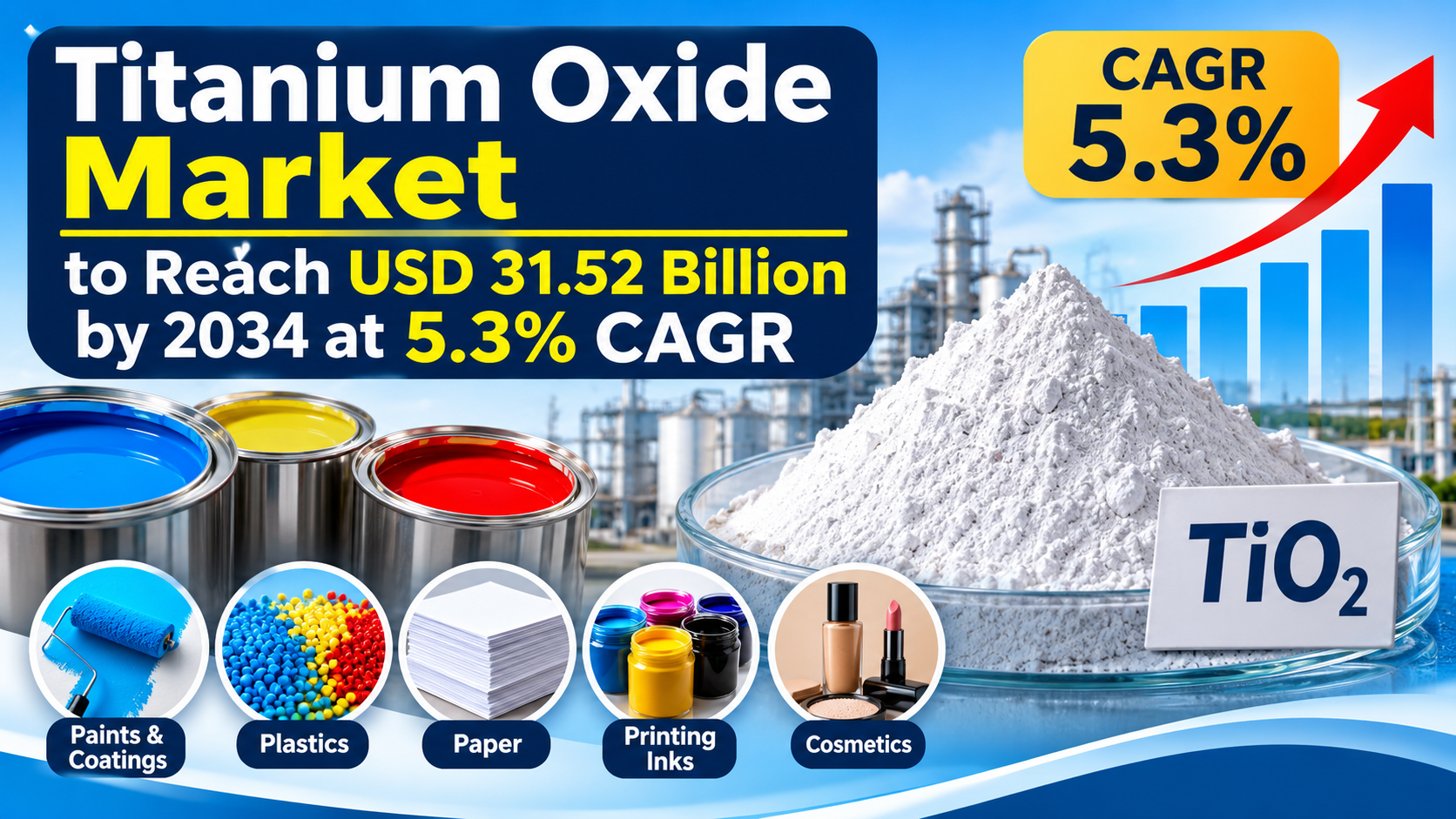
Global Titanium Oxide Market is gaining attention across paints and coatings, plastics, paper, printing inks, cosmetics, and specialty industrial applications. Titanium oxide, led commercially by titanium dioxide (TiO2), is the world's primary white pigment, providing opacity, brightness, and durability across various industrial products. Rutile dominates pigment-grade applications because of its high refractive index and weatherability, while anatase and ultrafine grades serve paper, cosmetics, photocatalysis, and other specialty applications.
According to 24ChemicalResearch latest industry analysis, the global Titanium Oxide Market was valued at USD 19.80 billion in 2025 and is estimated at USD 20.85 billion in 2026. The market is projected to reach USD 31.52 billion by 2034, growing at a compound annual growth rate (CAGR) of 5.3% during the 2026–2034 forecast period. Demand is supported by construction, renovation, plastics production, and consumer-product manufacturing. Asia-Pacific represents the largest production and consumption region, led by China, while North America and Europe retain major chloride-process capacity and premium coating applications.
View the complete report: https://www.24chemicalresearch.com/reports/275816/global-titanium-oxide-market
What Is Driving the Titanium Oxide Market?
Three primary forces are shaping market development, including demand from paints and coatings, industry capacity rationalization, and environmental compliance and production-process selection.
Strong Demand from Paints and Coatings
Architectural and industrial coatings consume the largest share of titanium dioxide because the pigment provides opacity, whiteness, UV resistance, and durability. Paints and coatings account for more than 55% of titanium dioxide consumption in the current market estimate. Housing, infrastructure, and industrial maintenance remain important volume drivers across major regions. Demand from coatings manufacturers continues to support the use of high-performance titanium oxide grades.
Capacity Discipline and Industry Rationalization
The titanium oxide industry has experienced a prolonged downturn, leading to plant closures and capacity rationalization. KRONOS reported that Tronox closed a 90,000-ton chloride facility in the Netherlands during 2025 and announced the closure of a 46,000-ton sulfate facility in China in 2026. Reduced inefficient capacity can support utilization and pricing, although new Chinese chloride-process capacity continues to increase competitive pressure.
Environmental Compliance and Production Process Selection
Environmental controls for acidic waste, iron salts, chlorine, and energy use add capital and operating costs for titanium oxide producers. Chloride-process plants generally offer strong pigment quality and lower solid-waste generation, while sulfate technology remains flexible across a wider range of feedstocks. Producers combining integrated ore supply, efficient process technology, and advanced surface treatment are better positioned to maintain margins across commodity cycles.
Market Challenges
Raw Material and Feedstock Cost Volatility
Ore quality, energy, chlorine or sulfuric acid, plant utilization, and surface-treatment costs determine titanium oxide production economics. Feedstock quality and impurity profiles strongly influence process yield, waste generation, and plant economics. Fluctuations in raw material and energy costs can affect manufacturing margins and competitiveness.
Environmental Compliance Costs
Environmental controls for acidic waste, iron salts, chlorine, and energy consumption increase capital and operating expenses. Producers must consider environmental requirements while selecting production technologies and managing their manufacturing operations. These factors influence regional competitiveness and investment decisions.
Cyclical Demand and Inventory Adjustments
The titanium oxide market is cyclical because large plants require high utilization and customers can destock pigment during weak construction or manufacturing periods. TiO2 destocking can materially affect quarterly demand because pigment users often carry several weeks of inventory. Changes in housing, construction, and industrial production can influence consumption and pricing.
View the complete report: https://www.24chemicalresearch.com/reports/275816/global-titanium-oxide-market
Market Opportunities
Growth in Premium Chloride-Process Pigments
China is moving further into premium chloride-process pigment production. LB Group already produces sulfate- and chloride-process pigments and in 2026 launched Tioxide as a subsidiary for premium chloride-process grades. This development demonstrates increasing competition beyond commodity sulfate material and creates opportunities in higher-performance pigment applications.
Specialty and Application-Specific Titanium Dioxide
Specialty and application-specific TiO2 grades are gaining importance across exterior coatings, engineering plastics, and other high-performance uses. Tronox markets ultrafine and specialty TiO2 through its CristalACTiV portfolio, while Chemours and KRONOS maintain application-specific pigment grades. Customers increasingly seek pigments optimized for exterior durability, high-opacity coatings, engineering plastics, and lower formulation costs.
Improved Pigment Efficiency and Surface Treatment
Manufacturers can create opportunities by improving pigment efficiency and developing advanced surface treatments. Surface treatments and micronization add production costs but can significantly improve coatings and plastics performance. Optimized particle spacing and extenders can also help formulators reduce TiO2 usage, particularly when pigment prices rise.
Integrated Feedstock Supply and Production Efficiency
Integrated mineral-sands supply can reduce exposure to external feedstock price fluctuations. Higher-grade rutile or slag can lower waste and reagent requirements in suitable production processes. Manufacturers combining feedstock integration, energy efficiency, and application-specific surface chemistry can strengthen their competitive position.
View the complete report: https://www.24chemicalresearch.com/reports/275816/global-titanium-oxide-market
Market Segmentation Insights
The Titanium Oxide Market is segmented by type, application, production process, end user, and product grade. Each segment serves different industrial requirements and purchasing specifications.
By Type
The market includes Rutile Titanium Dioxide, Anatase Titanium Dioxide, and Ultrafine / Specialty TiO2. Rutile dominates pigment-grade applications because it offers a high refractive index and strong weatherability. Anatase is used in selected paper, indoor coating, and specialty applications where different optical properties are preferred. Ultrafine and specialty TiO2 grades target photocatalysis, UV management, and high-value functional applications.
By Application
Key application segments include Paints & Coatings, Plastics, Paper, Printing Inks, and Cosmetics & Specialty Uses. Paints and coatings represent the leading application segment, accounting for more than 55% of titanium dioxide consumption in the current market estimate. Plastics, paper, printing inks, cosmetics, and specialty applications also contribute to overall market demand.
By Production Process
The market is divided into Chloride Process and Sulfate Process. Chloride-process plants generally offer strong pigment quality and lower solid-waste generation. Sulfate technology remains flexible across a wider range of feedstocks. Production economics depend on feedstock quality, environmental controls, energy requirements, and process efficiency.
By End User
Major end-user segments include Coatings Manufacturers, Plastics Compounders, Paper Producers, Ink Manufacturers, and Cosmetics & Specialty Chemical Companies. These customers qualify titanium oxide grades according to opacity, tint strength, durability, dispersion, and formulation stability.
By Product Grade
The market includes Pigment Grade, Food / Cosmetic Grade, and Ultrafine / Photocatalytic Grade. Pigment-grade titanium dioxide serves major coatings and plastics applications, while food and cosmetic grades and ultrafine or photocatalytic grades address specialized product requirements.
Regional Market Analysis
North America
North America remains a major premium pigment market with large coatings, plastics, and construction demand. Chemours has a particularly strong regional production position, with KRONOS stating that Chemours holds about one-half of North American TiO2 production capacity. The United States also has integrated chloride-process plants and large architectural-coatings customers. Demand is closely tied to housing, remodeling, automotive, and durable-goods production.
Europe
Europe is a mature but technically demanding market focused on coatings, plastics, paper, and specialty applications. Germany, the United Kingdom, Belgium, and Central Europe host important plants and customers. Capacity rationalization has reduced some older assets, including Tronox's 90,000-ton Dutch chloride plant closure in 2025. Environmental compliance, energy costs, and product carbon footprint strongly influence regional competitiveness.
Asia-Pacific
Asia-Pacific is the largest production and consumption region, led by China. China has expanded both sulfate- and chloride-process output and exports substantial pigment volumes. India and Southeast Asia add fast construction and plastics demand, while Japan remains important in specialty grades and high-performance applications. LB Group represented an estimated 14% of world production capacity in 2025, according to KRONOS.
Latin America
Latin America is a smaller production region but has meaningful demand from Brazil and Mexico in architectural coatings, plastics, and paper. Most customers rely on local distributors and imported pigment. Currency, freight, and housing cycles influence consumption. Brazil is the largest regional market, while Mexico benefits from manufacturing integration with North America.
Middle East & Africa
Middle East and Africa demand is driven by construction coatings, plastics, infrastructure, and regional manufacturing. Gulf countries have high per-capita coatings use tied to construction, while Africa remains more price-sensitive and import-dependent. Local production is limited, making freight and distributor inventory important. Turkey, Saudi Arabia, the UAE, and South Africa are the most relevant markets.
Competitive Landscape
The global Titanium Oxide Market includes established producers competing through production capacity, feedstock integration, chloride-process technology, pigment quality, global logistics, and application-specific surface treatment.
Major companies operating in the market include:
-
LB Group
-
The Chemours Company
-
Tronox Holdings
-
KRONOS Worldwide
-
Ishihara Sangyo Kaisha
-
TAYCA Corporation
-
Cinkarna Celje
-
Precheza
-
Travancore Titanium Products
-
Venator Materials
KRONOS estimated 2025 global production-capacity shares at 14% for LB Group, 11% for Chemours, 11% for Tronox, and 6% for KRONOS. Competition centers on production scale, ore integration, process technology, product quality, and customer qualification.
View the complete report: https://www.24chemicalresearch.com/reports/275816/global-titanium-oxide-market
Recent Developments in the Titanium Oxide Market
Premium Chloride-Process Expansion – 2026
LB Group launched Tioxide as a new subsidiary manufacturing TIOXIDE and DELTIO premium chloride-process titanium dioxide pigments. This development reflects the increasing focus on premium chloride-process products and higher-performance pigment grades.
Current Market Recovery – 2026
Tronox reported Q2 2026 TiO2 revenue of USD 700 million, up 19% year over year, alongside improved pricing expectations for Q3.
Market Outlook, 2026–2034
Through 2034, titanium oxide demand is expected to grow with coatings, plastics, and infrastructure, while industry profitability will depend on capacity discipline and raw material costs. Asia-Pacific will remain the production center, but premium chloride-process and specialty grades are expected to gain share globally. Producers combining integrated feedstocks, energy efficiency, and application-specific surface treatment are likely to strengthen their competitive position.
Report Summary
The Titanium Oxide Market is witnessing steady growth supported by demand from paints and coatings, plastics, construction, and specialty industrial applications. Increasing importance of premium chloride-process pigments, specialty TiO2 grades, production efficiency, and environmental compliance is shaping the competitive landscape. Asia-Pacific remains the largest production and consumption region, while North America and Europe maintain significant premium pigment markets.
Key Report Highlights
-
The global Titanium Oxide Market was valued at USD 19.80 billion in 2025.
-
The market is estimated at USD 20.85 billion in 2026.
-
The market is projected to reach USD 31.52 billion by 2034.
-
The market is expected to expand at a CAGR of 5.3% during the 2026–2034 forecast period.
-
Asia-Pacific is the largest production and consumption region, led by China.
-
Paints and coatings account for more than 55% of titanium dioxide consumption in the current market estimate.
-
Coatings and plastics together account for more than 80% of global TiO2 consumption, according to Tronox.
-
Rutile dominates pigment-grade applications because of its high refractive index and weatherability.
-
Major companies include LB Group, Chemours, Tronox, KRONOS Worldwide, Ishihara Sangyo Kaisha, TAYCA Corporation, Cinkarna Celje, Precheza, Travancore Titanium Products, and Venator Materials.
-
The report covers market size, forecasts, crystal forms, applications, production processes, end users, product grades, regional demand, country analysis, feedstock economics, competing pigments, and recent capacity developments.
Frequently Asked Questions About the Titanium Oxide Market
Q: What is the current size of the global Titanium Oxide Market?
A: The global Titanium Oxide Market was valued at USD 19.80 billion in 2025 and is estimated at USD 20.85 billion in 2026.
Q: What is the projected market size by 2034?
A: The market is projected to reach USD 31.52 billion by 2034.
Q: What is the expected CAGR of the Titanium Oxide Market?
A: The market is projected to grow at a compound annual growth rate (CAGR) of 5.3% during 2026–2034.
Q: Which region leads the Titanium Oxide Market?
A: Asia-Pacific is the largest production and consumption region, led by China.
Q: Which application uses the most titanium dioxide?
A: Paints and coatings are the largest application, accounting for more than 55% of consumption in the current market estimate.
Q: What is the difference between rutile and anatase TiO2?
A: Rutile is preferred for high-opacity and weather-resistant pigment applications, while anatase is used in selected paper, indoor coating, and specialty applications.
Q: Who are the largest titanium dioxide producers?
A: LB Group, Chemours, Tronox, and KRONOS are among the largest global producers by capacity.
Q: Why is titanium dioxide used in paint?
A: TiO2 provides whiteness, opacity, brightness, and UV durability at relatively low pigment loading.
Q: What drives titanium dioxide prices?
A: Ore, chlorine or sulfuric acid, energy, plant utilization, freight, and regional supply-demand balance are major price drivers.
Q: Is chloride-process TiO2 gaining share?
A: Yes. New chloride-process capacity, especially in China, is increasing competition in higher-performance pigment grades.
View the complete report: https://www.24chemicalresearch.com/reports/275816/global-titanium-oxide-market
Download the free sample report: https://www.24chemicalresearch.com/download-sample/275816/global-titanium-oxide-market
Contact Us
Website: https://www.24chemicalresearch.com/
Asia: +91 9169162030
 Spanish
 English
 Arabic
 French
 Portuguese
 Deutsch
 Turkish
 Dutch
 Italiano
 Russian
 Romaian
 Portuguese (Brazil)
 Greek