


Global Topological Insulator Market to Reach USD 792.8 Million by 2032 at 11.7% CAGR
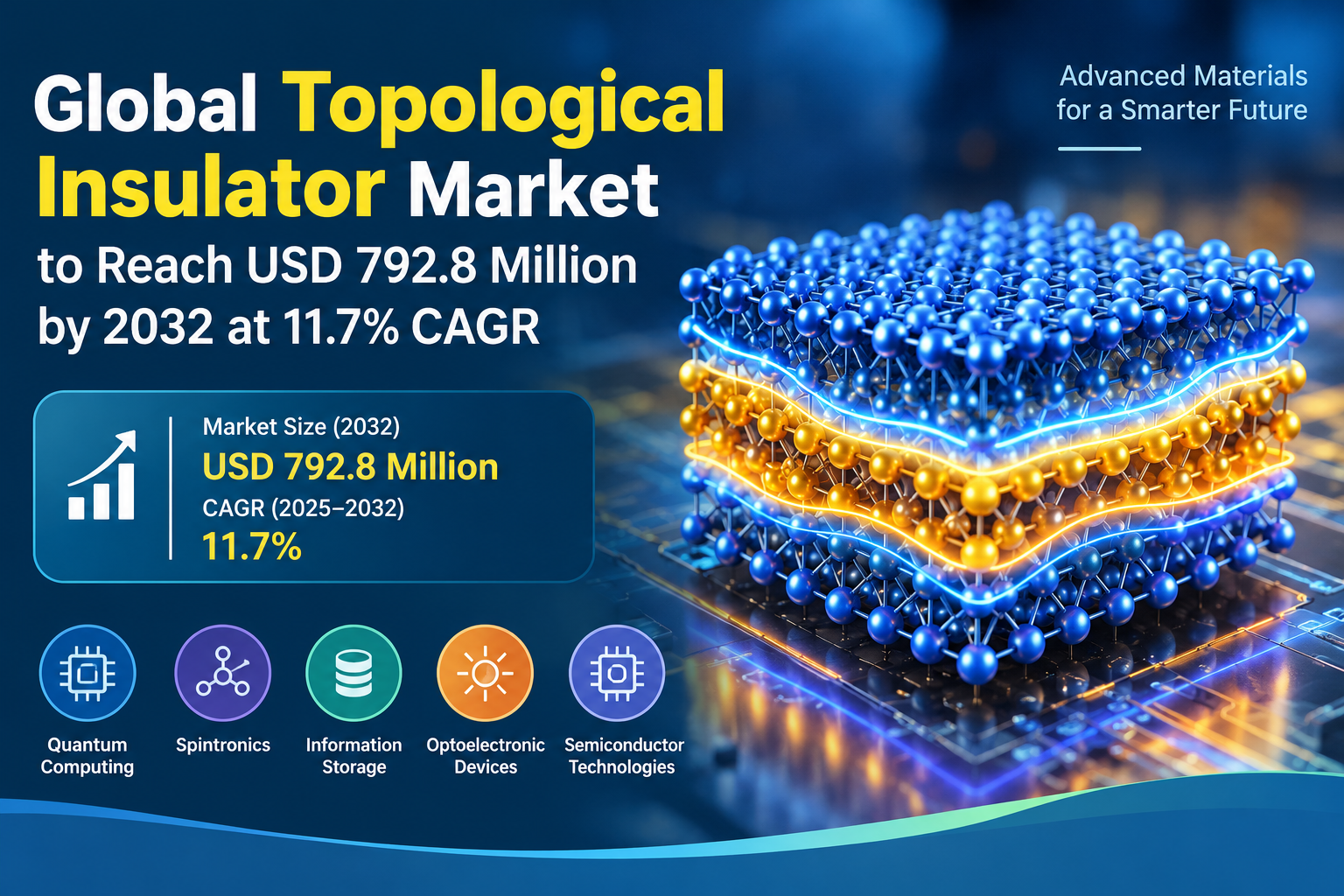
The global Topological Insulator Market is gaining attention across quantum computing, spintronics, information storage, optoelectronic devices, semiconductor technologies, and next-generation electronics. Topological insulators are advanced quantum materials that behave as electrical insulators internally while allowing electrical conduction along their surfaces. These unique electronic properties make them relevant to research into advanced computing systems, energy-efficient electronics, and innovative semiconductor devices.
According to 24ChemicalResearch, the global Topological Insulator Market was valued at USD 327.5 million in 2024. The market is projected to grow from USD 386.2 million in 2025 to USD 792.8 million by 2032, registering a compound annual growth rate (CAGR) of 11.7% during the forecast period.
Market development is supported by increasing research and development investment in quantum materials, demand for energy-efficient electronic components, and advancements in nanotechnology. Continued research into topological materials is also creating opportunities in quantum computing, information storage, and advanced optoelectronic devices.
Read the Complete Global Topological Insulator Market Report:
https://www.24chemicalresearch.com/reports/277383/global-topological-insulator-market
Topological Insulator Market: Industry Overview
The Topological Insulator Market focuses on advanced quantum materials characterized by distinctive electronic properties. Unlike conventional materials, topological insulators can conduct electricity along their surfaces while their interiors behave as electrical insulators. These characteristics have attracted interest from researchers working in quantum computing, spintronics, semiconductor technologies, and next-generation electronic devices.
The market includes different material categories, such as weak topological insulators, topological crystal insulators, and high-order topological insulators. These materials are being investigated for their potential to support advanced electronic architectures, specialized computing systems, and emerging information-processing technologies.
Demand is influenced by developments in quantum technology, nanotechnology, semiconductor research, and advanced materials science. Academic institutions, electronics manufacturers, semiconductor companies, and national laboratories contribute to research, material development, and early-stage commercialization.
Although the market remains at an emerging stage of commercial development, continued investment in material synthesis, device integration, and application research is creating opportunities for future industry growth.
Read the Complete Global Topological Insulator Market Report:
https://www.24chemicalresearch.com/reports/277383/global-topological-insulator-market
What Is Driving the Topological Insulator Market?
Growing Demand for Quantum Computing Applications
Quantum computing is an important area of research for topological insulators. Researchers are investigating whether these materials can support quantum devices and help address challenges associated with the stability of quantum information.
Technology companies, universities, and government research programs are investing in quantum materials and related technologies. This research supports demand for specialized materials used in experimental systems, prototype devices, and advanced scientific investigations.
As research progresses toward practical quantum applications, topological insulators may become increasingly relevant to the development of next-generation computing architectures.
Increasing Investment in Advanced Materials Research
Advanced materials research and development supports the discovery, synthesis, and characterization of topological materials. Academic institutions and specialized laboratories are working to improve material quality and understand the electronic properties that determine potential applications.
This research creates demand for high-quality samples, thin films, bulk crystals, and nanoscale material structures. Collaboration between universities, laboratories, and commercial organizations also supports the investigation of new applications.
Continued progress in material synthesis and characterization will be important to developing topological insulators for specialized electronic and quantum technologies.
Read the Complete Global Topological Insulator Market Report:
https://www.24chemicalresearch.com/reports/277383/global-topological-insulator-market
Rising Demand for Energy-Efficient Electronics
The electronics industry continues to investigate materials that could improve energy efficiency and electronic performance. Topological insulators are being studied for their potential use in advanced logic devices, information storage, and low-power electronic systems.
Their distinctive surface-conduction properties have attracted interest from researchers seeking alternatives or complements to conventional semiconductor technologies.
Progress in material synthesis, device engineering, and semiconductor integration could create additional opportunities as electronic systems require greater speed, functionality, and energy efficiency.
Advancements in Nanotechnology and Semiconductor Research
Nanotechnology and semiconductor research are helping scientists investigate topological materials at smaller scales and explore their integration into electronic devices.
Developments in thin-film deposition, material characterization, and nanoscale fabrication are important for improving material quality and supporting experimental device development.
These advances are relevant to potential applications in optoelectronic devices, chip interconnect structures, and specialized information-storage technologies.
Read the Complete Global Topological Insulator Market Report:
https://www.24chemicalresearch.com/reports/277383/global-topological-insulator-market
Manufacturing Costs and Market Challenges
The Topological Insulator Market faces several technical and commercial challenges associated with material synthesis, quality control, and integration into existing electronic manufacturing processes.
High Manufacturing Costs and Complex Fabrication
Producing high-quality topological insulators can require specialized equipment, controlled processing conditions, and advanced material-synthesis techniques.
Achieving the required electronic properties and material consistency can make production complex and costly. These challenges can restrict access for smaller research institutions and early-stage companies while making large-scale commercial production more difficult.
Improving manufacturing efficiency, process reproducibility, and material availability will be important to wider adoption.
Material Purity and Quality Requirements
Topological insulators require suitable material properties to maintain their intended electronic behavior. Impurities and defects can affect surface conduction and reduce performance in experimental or device applications.
Manufacturers and research institutions must therefore focus on material purity, structural quality, and consistent characterization.
Continued progress in synthesis techniques and quality-control methods may help address these challenges and improve the suitability of topological materials for advanced electronic applications.
Integration with Existing Semiconductor Processes
Integrating topological insulators into existing semiconductor manufacturing processes presents technical challenges. Established fabrication methods may not always preserve the specific electronic properties required for these materials.
Researchers must address issues involving deposition, interfaces, device architecture, and compatibility with other materials.
Successful integration will be important to moving topological insulators from laboratory research toward scalable electronic applications.
Read the Complete Global Topological Insulator Market Report:
https://www.24chemicalresearch.com/reports/277383/global-topological-insulator-market
Topological Insulator Market Segmentation
The Topological Insulator Market is segmented by type, application, end user, material form, and research focus. These categories reflect the different materials, potential uses, and research activities associated with the industry.
By Type
The market includes the following categories:
-
Weak Topological Insulator
-
Topological Crystal Insulator
-
High-Order Topological Insulator
High-order topological insulators are attracting research interest because of their distinctive conductive states and potential applications in advanced electronic and quantum devices.
Weak topological insulators and topological crystal insulators also contribute to research into the electronic properties and potential applications of topological materials.
Further progress in material synthesis, stability, and integration will influence the development of these categories.
By Application
The market covers the following application areas:
-
Information Storage
-
Optoelectronic Devices
-
Chip Interconnect Structure
-
Quantum Computing
Quantum computing is an important application area because researchers are investigating the potential of topological materials to support advanced quantum devices.
Information storage is another area of interest as researchers explore new material approaches to electronic memory and data-processing technologies.
Optoelectronic devices and chip interconnect structures represent additional areas of investigation, particularly where researchers seek to use distinctive electronic properties to improve device functionality.
By End User
The market includes the following end-user categories:
-
Academic & Research Institutions
-
Electronics & Semiconductor Industry
-
Defense and National Laboratories
Academic and research institutions represent a primary end-user category because they conduct fundamental research, material characterization, and early-stage application development.
The electronics and semiconductor industry is exploring the potential integration of topological materials into advanced devices. Defense and national laboratories also contribute through specialized research programs and technology development.
Collaboration across these end-user groups supports material science research and potential commercialization.
By Material Form
The market includes the following material forms:
-
Thin Films
-
Bulk Crystals
-
Nanostructures & Nanowires
Thin films are an important material form because they may be compatible with selected semiconductor and microelectronic fabrication approaches.
Bulk crystals are used in research requiring high-quality crystalline materials, while nanostructures and nanowires allow researchers to investigate topological properties at smaller scales.
Progress in deposition, crystal growth, and nanoscale fabrication will influence the availability and performance of these material forms.
By Research Focus
The market includes the following research categories:
-
Material Synthesis & Discovery
-
Device Prototyping & Integration
-
Theoretical Modeling
Device prototyping and integration are important research areas because they connect fundamental material discoveries with potential practical applications.
Material synthesis and discovery remain essential to producing high-quality samples and understanding their properties. Theoretical modeling helps researchers investigate electronic behavior and guide the design of materials and device structures.
Together, these research activities support the development of potential applications in quantum computing and advanced electronics.
Regional Topological Insulator Market Outlook
The global Topological Insulator Market includes research and development activity across regions with established scientific institutions, advanced materials laboratories, and semiconductor industries.
North America
North America is an important market for topological insulators because of its research infrastructure, government support, and activity in advanced materials and quantum technologies.
Universities, national laboratories, and private technology companies contribute to research into topological materials and their potential applications in quantum computing, information storage, and advanced electronic devices.
The region's research ecosystem supports material development, characterization, and collaboration between academic and commercial organizations.
Asia-Pacific
Asia-Pacific is an important and developing region for topological insulator research, supported by semiconductor industry expansion and investment in advanced electronics.
China, Japan, and South Korea participate in research and development involving quantum materials and next-generation semiconductor technologies.
Government initiatives, university research programs, and electronics manufacturing capabilities contribute to the region's potential. Continued investment in material science and quantum technology may support future market development.
Europe
Europe contributes to topological insulator research through academic institutions, advanced materials laboratories, and scientific collaborations.
Research into quantum materials and advanced electronics supports demand for specialized samples and experimental materials.
Collaboration between universities, laboratories, and industry can help advance material characterization and investigate potential applications in electronic and optoelectronic technologies.
South America
South America represents an emerging area for research and development involving advanced materials.
Market activity depends on the availability of specialized research facilities, investment, scientific collaboration, and access to high-quality materials.
Academic and research institutions may contribute to investigations of quantum materials and their potential applications as regional research capabilities develop.
Middle East & Africa
The Middle East and Africa region offers longer-term opportunities through investment in scientific research, technology development, and innovation infrastructure.
Some Gulf Cooperation Council countries, including Saudi Arabia and the United Arab Emirates, have invested in research and technology initiatives that may support future participation in advanced materials research.
Commercial development remains at an emerging stage, with progress depending on research funding, institutional capabilities, and collaboration with established global research centers.
Competitive Landscape: Topological Insulator Market
The Topological Insulator Market includes specialized material suppliers and research organizations involved in material discovery, synthesis, characterization, and distribution.
Competition is influenced by material quality, purity, availability, research expertise, production capabilities, and the ability to supply materials for specialized applications.
Because the market is still developing, research institutions and specialized suppliers play an important role in advancing the field. Commercial suppliers support academic and industrial research by providing high-purity samples and materials in different forms.
Key Companies and Organizations Profiled
The report profiles the following organizations:
-
Argonne National Laboratory
-
Tokyo Chemical Industry Co., Ltd. (TCI)
-
HQ Graphene
-
MKnano
-
2Dsemiconductors
These organizations participate in different aspects of the topological insulator ecosystem, including research, advanced materials, and the supply of specialized samples.
The competitive environment is influenced by technological innovation, material quality, intellectual property, research partnerships, and the ability to meet the requirements of specialized customers.
Read the Full Report for Detailed Market Data:
https://www.24chemicalresearch.com/reports/277383/global-topological-insulator-market
Key Report Highlights
-
Market Value in 2024: USD 327.5 million.
-
Market Value in 2025: USD 386.2 million.
-
Projected Market Value by 2032: USD 792.8 million.
-
Expected CAGR: 11.7%.
-
Key Material Categories: Weak Topological Insulators, Topological Crystal Insulators, and High-Order Topological Insulators.
-
Key Applications: Information Storage, Optoelectronic Devices, Chip Interconnect Structure, and Quantum Computing.
-
Primary End Users: Academic & Research Institutions, Electronics & Semiconductor Industry, and Defense and National Laboratories.
-
Important Material Forms: Thin Films, Bulk Crystals, and Nanostructures & Nanowires.
-
Key Research Areas: Material Synthesis & Discovery, Device Prototyping & Integration, and Theoretical Modeling.
-
Growth Opportunities: Quantum technology research, advanced materials development, energy-efficient electronics, and semiconductor innovation.
-
Main Challenges: Manufacturing complexity, high production costs, material purity requirements, and integration with existing semiconductor processes.
-
Profiled Organizations: Argonne National Laboratory, Tokyo Chemical Industry Co., Ltd. (TCI), HQ Graphene, MKnano, and 2Dsemiconductors.
Get the Complete Market Report:
https://www.24chemicalresearch.com/reports/277383/global-topological-insulator-market
Get the Free Sample Report:
https://www.24chemicalresearch.com/reports/277383/global-topological-insulator-market
About 24ChemicalResearch
24ChemicalResearch provides market research and industry analysis covering chemicals, advanced materials, industrial applications, market trends, competitive landscapes, and market forecasts.
Contact Us
Website: 24ChemicalResearch
Phone: +91 9169162030
Email: help@24chemicalresearch.com
 English
 Arabic
 French
 Spanish
 Portuguese
 Deutsch
 Turkish
 Dutch
 Italiano
 Russian
 Romaian
 Portuguese (Brazil)
 Greek