


How Cognitive Games Help Improve Children's Thinking and Problem-Solving Skills
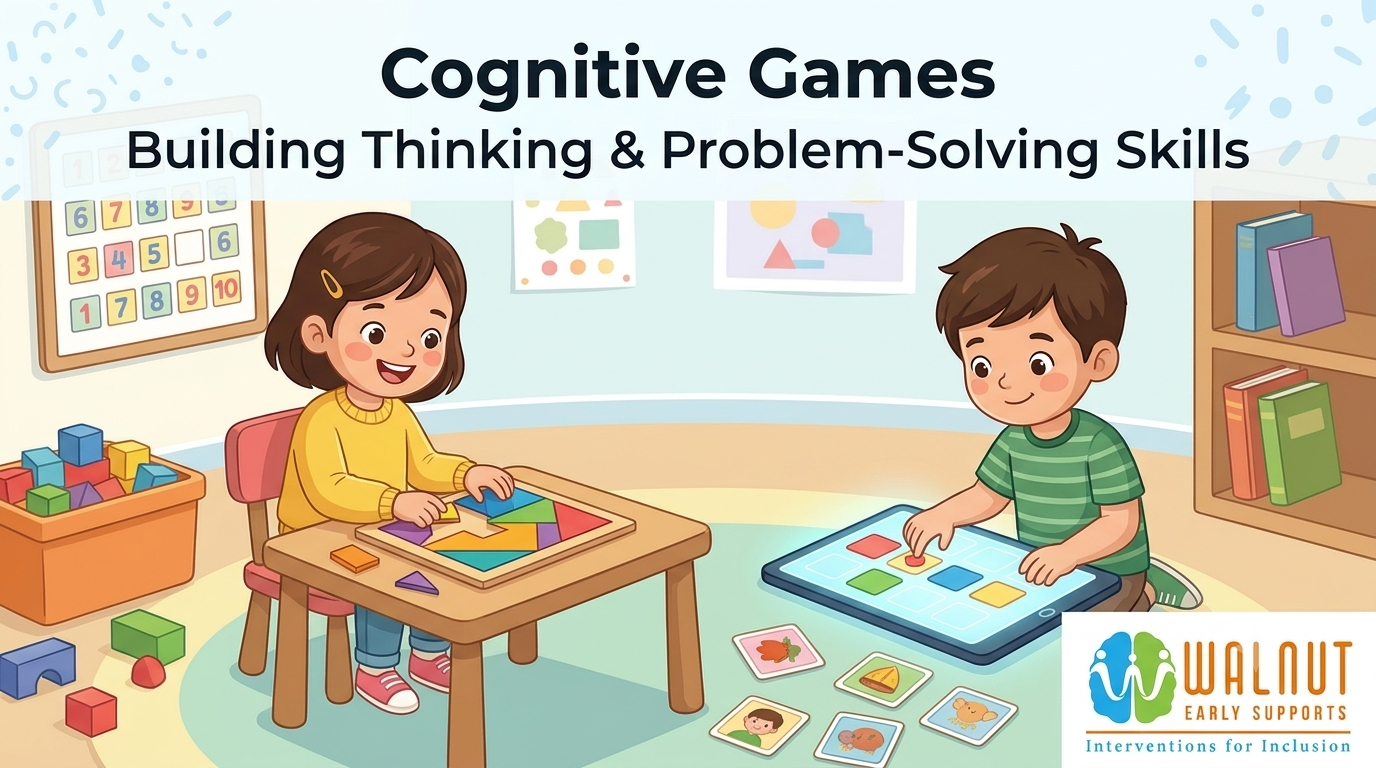
Children learn about the world by exploring, observing, asking questions, and trying new things. During childhood, their brains develop important skills that help them understand information, make decisions, remember things, and solve everyday problems. Play-based learning is one effective way to encourage these abilities.
Cognitive Games provide children with enjoyable opportunities to practise thinking, reasoning, memory, attention, and problem-solving. Instead of simply memorising information, children learn by participating in activities that challenge them to think, make choices, and find solutions.
These activities can be useful at home, in classrooms, and during therapy sessions. With suitable guidance and regular practice, they can support children's learning and overall development.
1. Understanding the Role of Cognitive Skills in Child Development
Cognitive skills are the mental abilities children use to process information, understand situations, and respond to different challenges. These skills develop gradually through everyday experiences and learning opportunities.
Some important cognitive skills include:
-
Memory: Remembering information, instructions, pictures, and experiences.
-
Attention: Staying focused on a particular activity or task.
-
Logical Reasoning: Understanding relationships, patterns, and sequences.
-
Problem-Solving: Finding ways to overcome difficulties.
-
Visual Processing: Recognising shapes, colours, positions, and differences.
-
Executive Functioning: Planning, organising, controlling impulses, and managing tasks.
When children practise these skills through enjoyable activities, they get opportunities to strengthen their ability to think independently and approach new situations with confidence.
2. How Cognitive Games Improve Thinking Skills
Children develop thinking skills when they are encouraged to explore different possibilities and make decisions. Games create opportunities for this kind of learning in an interesting and interactive way.
Here are some ways these activities can support children's thinking abilities.
Encouraging Logical Thinking
Matching activities, sequencing tasks, and pattern recognition games encourage children to identify connections between different objects or ideas.
For example, a child may be asked to arrange pictures in the correct order or identify which shape comes next in a pattern. These activities encourage observation, comparison, and logical reasoning.
Improving Memory and Recall
Memory-based activities encourage children to remember information and use it when needed.
Picture-matching games, remembering object sequences, and identifying missing items can help children practise visual and working memory. These skills are useful when following instructions, learning new concepts, and completing everyday tasks.
Strengthening Attention and Concentration
Some children find it difficult to remain focused on one activity for an extended period. Interactive games with clear instructions and achievable challenges can encourage them to pay attention.
Activities such as finding differences, identifying specific objects, and completing puzzles give children opportunities to practise concentration while enjoying the learning process.
3. How Games Develop Problem-Solving Abilities
Problem-solving is an important skill that children use in everyday situations. It helps them understand challenges, consider possible solutions, and decide what to do next.
Cognitive ability games can encourage children to approach problems step by step rather than expecting immediate answers.
For example, when completing a puzzle, children need to observe the available pieces, identify suitable matches, and try different combinations. If their first attempt does not work, they learn to try another approach.
This process encourages:
-
Decision-Making: Choosing the most suitable option from different possibilities.
-
Trial and Error: Learning from mistakes and trying alternative solutions.
-
Flexible Thinking: Understanding that a problem may have more than one solution.
-
Independent Thinking: Developing confidence in finding answers without depending entirely on others.
Parents and therapists can support this process by giving children enough time to think instead of immediately providing the answer.
4. Types of Games That Support Cognitive Development
Different activities target different thinking skills. Choosing a variety of activities helps children practise multiple abilities.
Some useful examples include:
Puzzle Games: Encourage visual recognition, spatial awareness, and problem-solving.
Memory Matching Games: Help children practise remembering pictures, objects, and their positions.
Sorting and Classification Games: Encourage children to group objects based on colour, size, shape, or category.
Sequencing Activities: Help children understand order, patterns, and the relationship between events.
Find the Difference Games: Encourage attention to detail, observation, and visual discrimination.
Pattern Recognition Games: Support logical thinking and the ability to identify repeating sequences.
These cognitive development games can be adjusted according to a child's age, learning ability, and individual needs. Starting with simple activities and gradually increasing the difficulty can help maintain interest.
5. The Role of Digital Games in Cognitive Learning
Technology has introduced new ways for children to participate in interactive learning activities. Digital games can combine pictures, sounds, instructions, and immediate feedback to make learning more engaging.
Digital child development therapy resources can provide structured activities that therapists and parents use to support specific learning goals.
For example, online matching, sequencing, memory, and visual reasoning activities allow children to practise different skills through a screen. Such activities can also be useful during online sessions and home-based learning.
However, screen-based activities should be selected carefully. They should have clear learning objectives, age-appropriate content, and simple instructions. Adult guidance and a healthy balance between screen-based and offline play remain important.
6. How Parents and Therapists Can Encourage Better Learning
Parents and therapists play an important role in helping children benefit from learning activities. The goal should not be to make children complete games quickly but to encourage them to understand, explore, and think.
Here are some practical suggestions:
-
Choose activities based on the child's current abilities and interests.
-
Start with simple challenges and gradually increase complexity.
-
Give children enough time to understand instructions and respond.
-
Ask questions such as "What do you think will happen next?" or "Can you find another way?"
-
Appreciate effort and participation rather than focusing only on correct answers.
-
Include short and enjoyable activities in daily routines.
-
Observe which activities the child enjoys and where additional support may be needed.
For children receiving speech therapy for kids, activities involving listening, remembering instructions, identifying pictures, and following sequences can also be incorporated into sessions when they match the child's individual communication goals.
7. Building Strong Thinking Skills Through Regular Practice
Every child develops at a different pace, and learning does not happen in the same way for everyone. Some children may quickly understand patterns, while others may need more repetition, visual support, or guidance.
The most effective approach is to provide meaningful learning opportunities without putting unnecessary pressure on children. A combination of play, conversation, everyday experiences, and structured activities can support their development.
Regular participation in suitable games gives children opportunities to practise important mental skills in an enjoyable environment. Over time, these experiences can help them become more confident in exploring ideas, making decisions, and approaching everyday challenges.
Conclusion
Thinking and problem-solving skills are essential parts of children's overall development. Through enjoyable and meaningful activities, children can practise memory, attention, logical reasoning, decision-making, and independent thinking.
When selected according to individual needs, games can make learning more interactive and encourage children to explore different ways of finding solutions. With patience, encouragement, and consistent practice, parents and therapists can create positive learning experiences that support children's growing abilities.

 English
 French
 Spanish
 Portuguese
 Deutsch
 Turkish
 Dutch
 Italiano
 Russian
 Romaian
 Portuguese (Brazil)
 Greek